homework 4
this homework is optional, meaning, you can do it if you want and get some extra credit. I strongly recommend you do these optional things, you will get more out of the class and it will challenge you. Please also try to document your solutions by recording a movie – it’ll help your pages and also your classmates.
a) using the point recorder code, create multiple point recorders instead of just one. Every time you draw, create another point recorder. Create a clear function. Can you use these multiple point recorders to create something interesting ? shoot a short video.
b) right now the playback of the point recorder is just one point (at time t), can you create a second point (at time time-1.0, ie time minus one second, for example) as in Scott Snibbe’s motionsketch ? It would be nice to use the total duration to figure out to space out multiple playbacks so they are equally divided.
c) in one example, point recorder is use to control the property of sound synthesis. can you use it to control some other properties of media, like playback position of a movie or opacity of some images? Think about all of the parameters you can get from the playback unit and how you can use them. Make some playful, creative system.
code from class 4
here’s the code from class 4 (point recorder / noise) wk_4
whitney readings
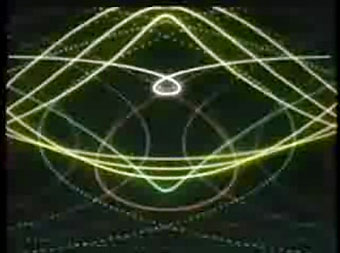
here are two readings about and from John Whitney
Expanded_Cinema (excerpt, by Gene Youngblood)
Digital Harmony (by John Whitney)
homework 3
a) make a composition using the animation techniques that is a tribute to john whitney. See for example:
profile, info, videos, catalog (made in 1961! non-digital!) , video we watched in class
b) Since we talked in class about this idea of a relationship between sound and visual synthesis (and harmony) find a short piece of music (can be any duration as long as there are multiple notes – a short snippet, or a long song) and make a composition that is a visual equivalent of that sound. Think about how the make a visual equivalent using the techniques we talked about this week. Post both the sound and the resulting animation. Try to bring out some essential truth of the audio through the visualization.
c) try to use sin and cos to emulate a natural phenomenon (ie, something you see in the natural world). be sure to provide some documentation (video / picture / text) of what this phenomenon is.
d) extend the xeno / atan2 code, making a creature which follows the mouse. think of how you could use sinusoidal animation techniques to give the object some “life” – breathing, blinking, etc.
(advanced)
e) since we talked about amplitude modulation in relationship to sin/cos animation, see if you can implement visual equivalents of other synthesis techniques, such as FM synthesis (modulating the carrier frequency) or additive synthesis. Make an interesting composition with what you’ve implemented.
finally, remember: every homework assignment is an opportunity for genius.
code from class 3
here’s code from week 3 — algo_wk3_fixed (sorry, the first zip had a bad example, so I’ve re-uploaded the code)
homework 2
homework 1
- make a flip book. Please use a “thicker” type sketchbook. I recommend the square sketchbooks from NY Central Art Supply.
- make three recordings (using a handheld camera that’s sationary) of three different scenes which have interesting motion. Pick one point to watch during the video, and sketch out it’s motion path. Try to find both rhythmic (repetitive) and organic motions.
- draw your name using openframeworks. upload a screenshot of your app, and a zip of the source code or project.
students